Can we replace Seedance with a tiny video model?
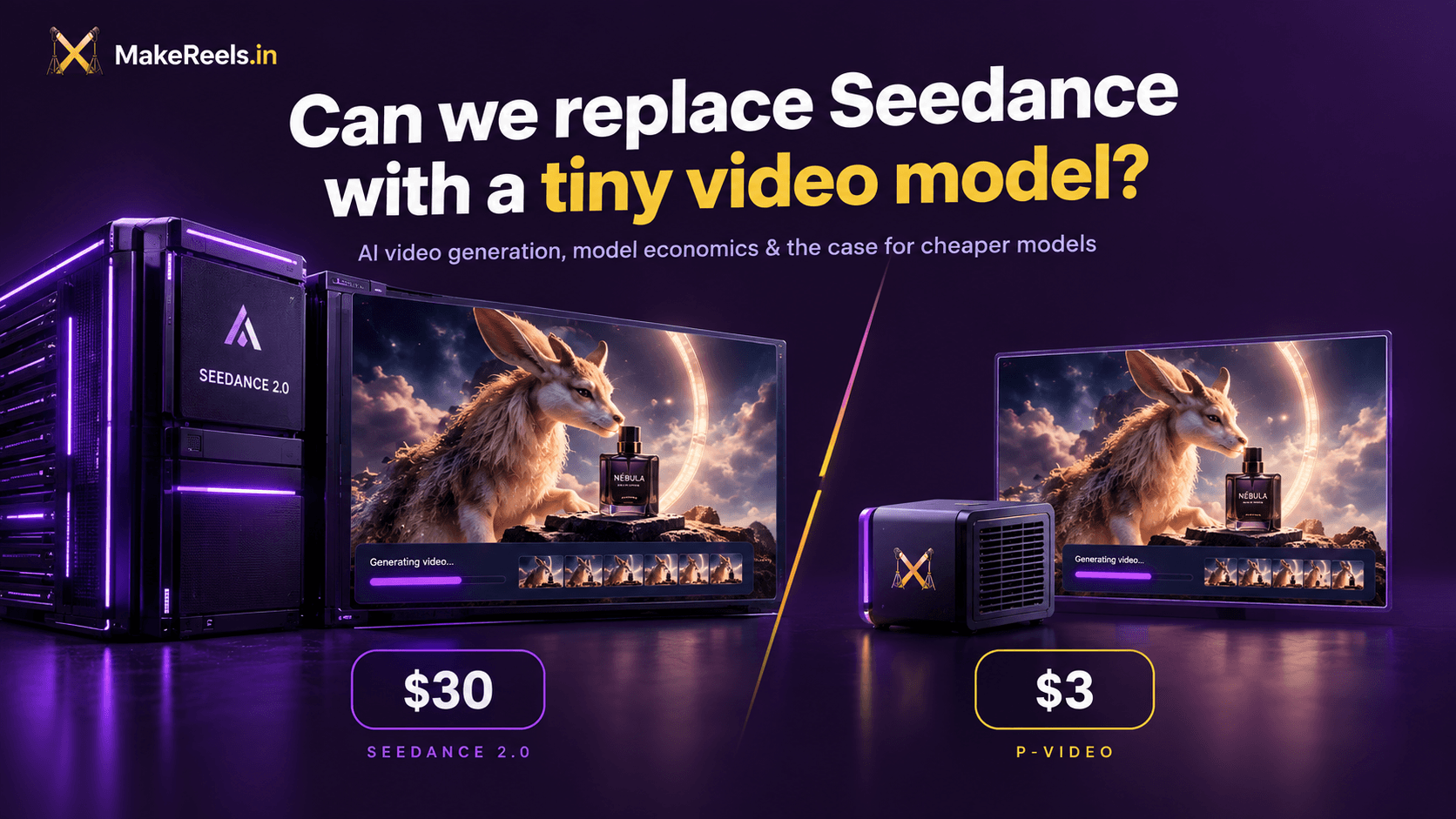
Don't get me wrong, Seedance 2.0 is a great model, but it is not always a great idea to use Seedance for your video. Especially so if your budget is tight. Here at MakeReels.in, the cost of video generation was one of our main priorities while building the platform. One thing that we decided early on was to simplify the model options by providing a standard tier and a best tier. We wanted to keep the product simple and put the right choices in front of the user.
Over the last year, seedance has won unanimous support from AI videographers around the world, and for a good reason too. It's easy to prompt, and it allows for a great degree of control. However, seedance can become expensive quickly. At 5 cents a second for the smallest seedance model, a single shot for a 90-second clip costs you around 4.50$. When you start factoring in the fact that you generally need 3-4 takes per shot to get the right emotion or action, and the costs of generating character sheets, set sheets and revisions. You're looking at around 25$ for a simple low-quality AI video. For many, this is not acceptable.
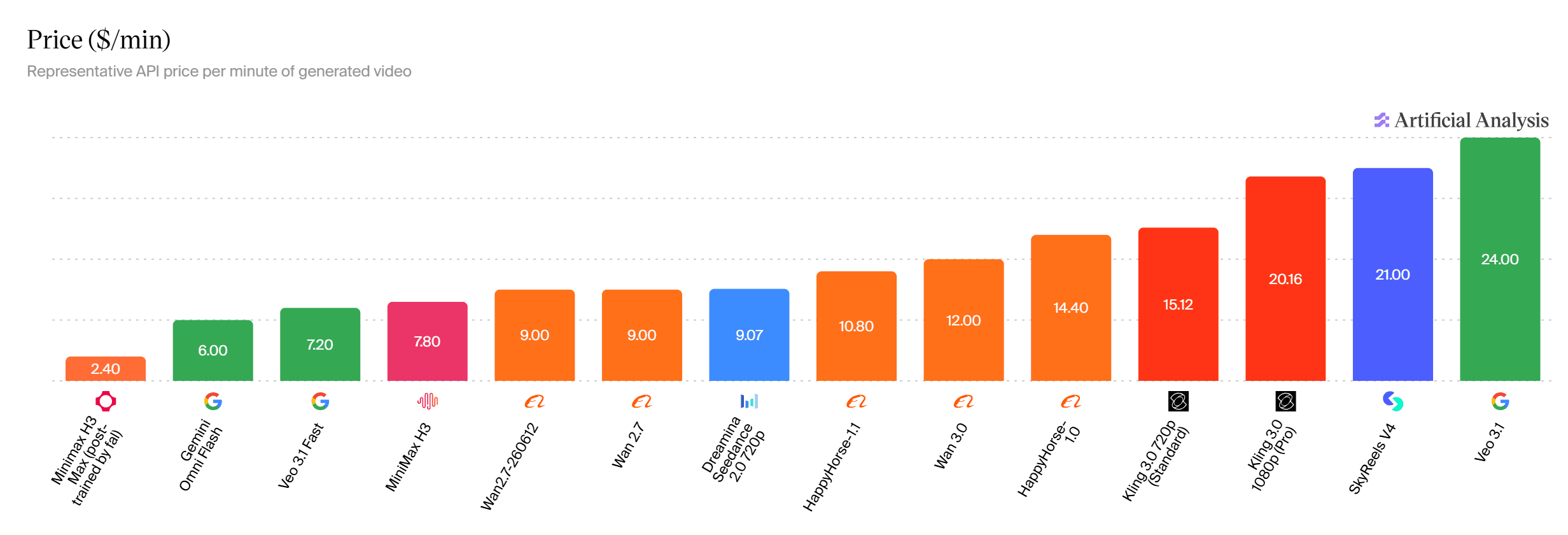
However, as video models keep improving, I keep asking myself if it's possible for smaller, newer models to be able to perform at the same level as yesterday's top models. To answer this question, I spent 2 months with the cheapest video model I could find over an API: p-video by Pruna AI, and I was shocked to find out that I might have been overpaying for Seedance.
Classifying AI videos
Before we get into understanding why the cheap model works, we must understand the types of videos that someone would make using AI. Most AI-generated content falls into two categories: informational and entertainment. Informational videos can be simple videos that don't always need an AI video model and can be generated quite easily using animations and large language models. So, most of the creators today are focused on entertainment, or a related field thereof.
Creating AI-generated ads is a popular emerging field due to its ability to generate surreal videos or physically improbable videos. They are used to catch attention and drive a point. I would point towards the recent Acko insurance ad campaign as a brilliantly executed AI Ad. They created hybrid animals that were a combination of two different animals and proved their point that a "half insurance - half investment" is a bad idea. As a consumer, I was mesmerised by the half dolphin-half lion on the billboard from the moment I saw it. It makes sense to use AI for such sensational content.
As consumers of media, we have become more wary of AI-generated content. We try to figure out if something was AI-generated or not, and in many cases, being AI-generated has obvious downsides. This has created a premium market which focuses on hyper-realistic video generation. This type of AI video is generally not possible on cheap AI video models, and it's better to consider spending top dollar to get the most realistic physics from the latest and greatest in AI video model innovation.
However, there is a growing market for videos that are intentionally AI-generated. A.K.A. AI Slop, a category of videos so absurd that only an AI could have made it. This is an interesting category because this is the only category where the quality of the video can be measured by its AI-ness. Most of its adoption has been driven through meme culture. The videos in this category can have crazy good returns. Some of the most viral content in the last decade has been fruit love island, cat family drama and not to mention the whole tung tung sahur meme. All of these trends were driven by AI-generated videos.
While being an absurd new genre, this genre is picking up pace very quickly and is becoming one of the most watched genres for some good reasons. These videos generally contain storylines and characters that are wild and amusing to look at; additionally, they often include storylines that are so random that you would not be able to guess them from a mile away and with the rise of short-form content, they serve as a good and easy-to-replicate trend. This is exactly why you, as a brand, need to get on this hyper-train. It is one of the best ways to go viral right now.
For a brand owner, all of these use cases are important and need to be met at different cost points. Informational content would need to be relatively cheap. This content does not have a huge monetisation angle; these videos can often be generated by using LLMs in clever ways instead of using a video model at all. Hyper-realistic videos are less of a cost challenge; they present a technology challenge. Therefore, these videos are generally quite expensive. Whereas, for the AI Slop category there is no standard, but it is likely to be a volume game, and the ability to copy characters is what matters the most, since latching onto trends is what people want to do in this category.
What does Seedance offer?
Seedance offers 2 variants, which helps cover a vast spectrum from 480p content at 5 cents per second to 1080p content at about 1$ per second on the higher model variant. They are one of the best video models out there, competing with the likes of Runway, Veo and Kling. The model's ability to model real-world physics is quite impressive and can handle tasks like fluid dynamics quite well, better than CGI could in many cases. For these reasons, people often rank Seedance as the best model.
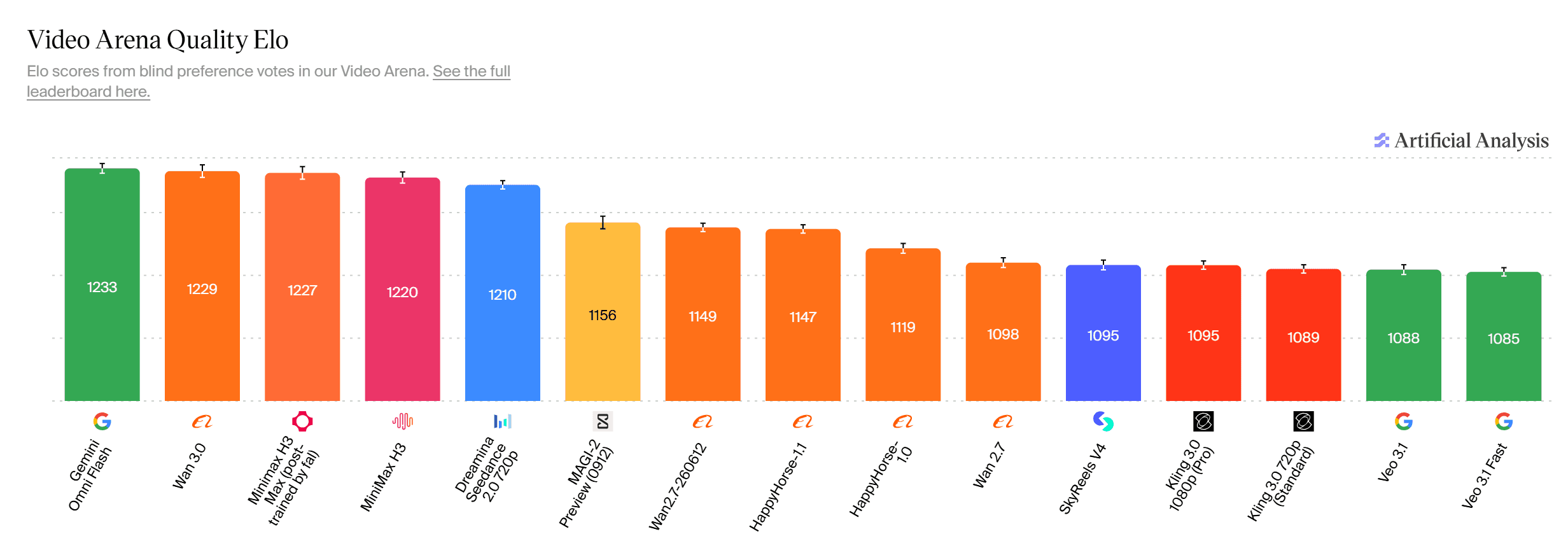
However, blind user tests on Artificial Analysis paint a different picture. Seedance is definitely one of the best models, but the best model keeps changing. Sometimes it's Wan, sometimes it's Happy Horse, sometimes it's Runway. The rankings keep changing, but most people within the AI video production community would quote Seedance as the best video model. This isn't because the other models are outright worse than Seedance, but rather because of another important nuance. If a picture is worth a thousand words, a video is worth at least 30,000 words per second. Video models are notoriously difficult to control. One wrong movement in frame 10 can ruin the final action to perform in frame 300. Due to this instability, video models are almost always going to generate totally distinct videos even if the prompt remains the same. For this reason, you're stuck regenerating the same prompt 2-3 times before being able to see a variant that you can work with.
As the video models improve, what has improved is the ability for the model to understand user prompts; however, this is not a uniform improvement across all prompts. Some models like Happy Horse by Alibaba are quite hard to control with prompts, whereas models like Seedance have spent years iterating on their models' ability to understand user prompts better. What this means is that, once you have worked with Seedance for long enough, you will most likely be able to understand what to expect from a prompt and how many takes would be needed to get a decent video out of the system. This is why most people will generalise and call Seedance one of the best models for video generation. And given how expensive bad videos can be, most users don't want to mess around with their video models. Changing the video model can cost thousands of dollars in learning curve.
Can cheaper models be better?
Yes and no, cheaper models can perform better in some situations, and in some they cannot. Let's start with the elephant in the room: cheaper models are not better at doing hyper-realistic motion videos. You can try making some really simple hyper-realistic videos by producing the video in such a way that your scene has as little camera movement and relatively simple character movements. But in reality, you're better off using Seedance-mini over a Wan model or a P-Video model.
Generating informational video can be done with LLMs using some hacks like asking the LLM to generate slides and talking points for the slides. The slides can be timed to the TTS clips result and rendered into an MP4. You can optimistically expect the cost of this to be around a dollar for a two-minute video. And you can use cheaper videos as B-rolls if needed to explain concepts or show the product. This is the type of use case that we focus on at MakeReels.in as well. These videos can be used for education, product awareness, taboo topics and demo reels.
The place where our cheaper model shines the most is at copying trends. This is one of the places where our harness around the cheaper model allows us to generate a higher volume of content while also getting the right surreal effect. Copying characters and generating storylines is where our system shines. Integrating this with our understanding of how to build product videos, we are able to deliver an interesting combination of viral content and product content. This is exactly the type of content that can help a product owner go viral.
Conclusion
At OneSol, we have built most of our stack around brand owners and have constantly taken feedback from our customers. We understand that for a business, the cost is important. Most businesses can benefit from cheap videos, be it corporate training videos, product how-tos or even viral marketing content. To enable this, we offer the standard tier in which we use some of the cheapest models to try and get the best outcome. You can compare the video outputs for the same prompt using p-video and seedance-2.0. The p-video model costs us around 3$ to generate, whereas the seedance-2.0 model costs us around 30$ to generate.